
How to do your own kitchen worktop repair, such as remove stains, water, scorch marks, chips or glue up joins in a wooden butcher's block. Includes how to video, simple tools you can use with little skill and results.

You know, I'm not a big fan of real wooden worktops in kitchens. It's a place that sees a variety of spills and requires ongoing TLC.
But when we bought our 57ft reverse layout narrowboat, the kitchen had a wooden butcher's block. And due to the obvious damage and discolouration, I wanted to immediately rip it out.
Yet, to buy worktops right now, they're more expensive than ever. And with cutting and fitting a kitchen countertop being more work than a wooden worktop restoration, I chose the latter.
There's absolutely no need to painfully install a worktop wrap!

Worktop Restoration Topics We'll Cover
During my butcher's block repair and restore, you'll learn about the following. Note, this also applies to an oak worktop restoration.
- Things I used in my worktop tool box
- How to re-glue worktop joints
- Easy kitchen worktop stain removal
- Kitchen worktop burn repair
- Worktop chip repair
- What wooden worktop varnish you can use
- Types of worktop oil
Kitchen Worktop Tutorials Already Covered
Note, we won't be covering laminate worktops, but you can read my previous how-tos here:
- How to fit kitchen worktop jointing strips
- Installing a kitchen sink in a laminate worktop
- Fitting a kitchen worktop taller than a windowsill

Things I Used in my Worktop Toolbox
Please note that as an Amazon Associate, I earn from qualifying purchases made through links.
- Hand saw
- D4 Resin glue by Egger - Closest one I could find!
- Bahco scraper
- Bahco replacement blades
- Harris scraper
- Cabinet scraper
- Bar Keeper's Friend
- Mini pull saw
- Belt sander
- Orbital sander
- 120 grit orbital sander disks
- 240 grit
- Rubber sanding block
- Exterior varnish
- Dust mask
- Paint brush
- Masking tape
- Ear defenders/headphones
- Gloves

What Is a Carbide Scraper Used For?
A carbide scraper is a very useful tool for scraping off paint, varnish and other blemishes on wooden surfaces, such as stains, water marks, burns, etc. Its carbon steel should last longer than other steel scrapers too and usually comes with carbide-tipped replaceable blades.
Alternatively, you can buy cheaper cabinet scrapers, but they'll require regular sharpening between uses. And honing your sharpening skills will require practice and more tools, such as a diamond bench stone, carbide burnisher etc.
If you're restoring a wooden worktop as a one-off or beginner, then I would opt for a carbide scraper instead.
Scraper Benefits
The reason I love scrapers, is that:
- They don't vibrate, unlike a sander, reducing Vibration White Finger
- Give a smooth finish
- Creates less dust
- They're quiet, unlike sanders
- No electricity needed
- Easy to access worktop upstands
- Reduces sanding time required!

Are the Bahco and Harris Carbide Scraper Blades Interchangeable?
Yes! The reason I bought a carbide tipped Harris scraper was because the Bahco carbide replacement blades are double the price! However, you'll need to tighten it slightly more.
Which Carbide Scraper Is Best?
The Bahco scraper gave marginally better shavings. So, not enough for double the price. The Bahco has a knob that is easier to put pressure on if your arms are tired. But, under my narrowboat's gunwales, the Harris fit underneath it, unlike the Bahco.
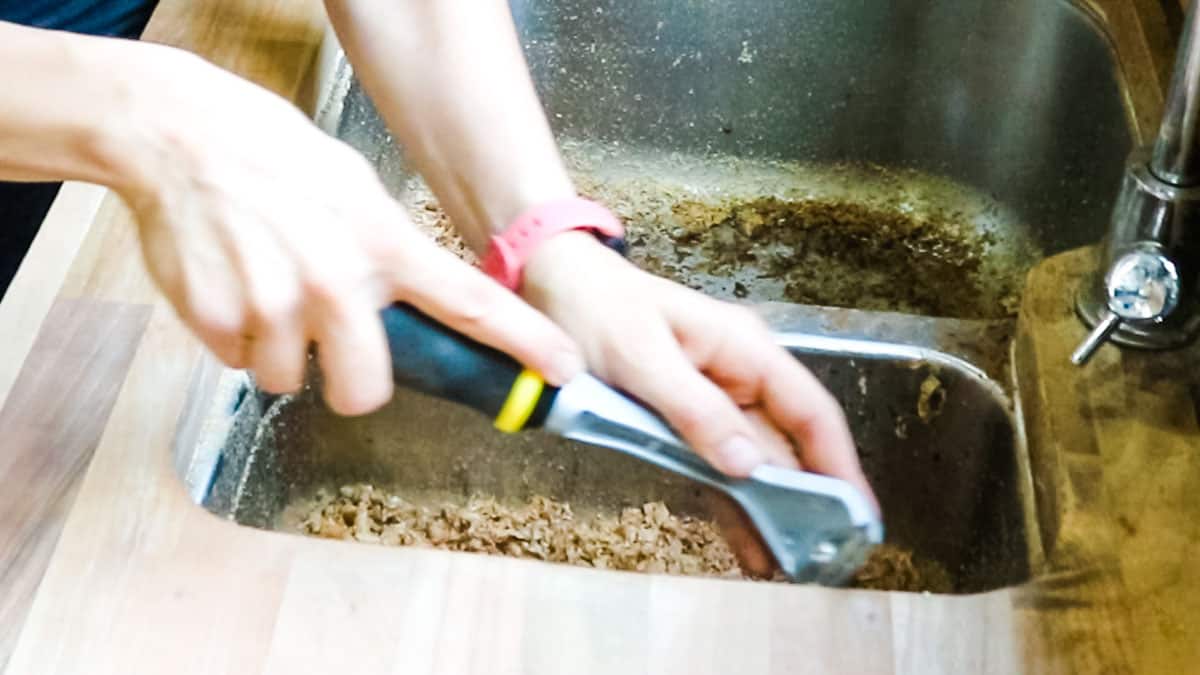
How Do You Use a Wood Scraper?
Here's a few quick tips for using a carbide scraper. But to refinish your wooden worktop, you'll need to remove any topcoats first:
- Go with the grain. If you go against, you can create unwanted dips
- Avoid sharp corners as the scraper can big, giving you unwanted steps. You're best using a sander for these
- In corners, such as wood against a wall, masking tape the wall to protect as the sharp edge can scratch
- Avoid over scraping in one area too much to prevent dips - for stubborn stains, or chips, see below
- Go gentle on the end grain, such as wooden worktops with undermount sinks
- Carefully unscrew things link a hob, providing you know you have a gas flexihose to avoid gas leaks. Or masking tape and gently sand around these areas

Easy Worktop Stain Removal With Bar Keeper's Friend
To remove stubborn stains off wood, then I recommend using oxalic acid, as opposed to scraping too much in one area.
Oxalic acid bleaches the wood and can quickly remove water stains, ring marks etc, without being too abrasive.
If you can't find oxalic acid, I recently discovered Bar Keeper's Friend which contains it. It's cheap and easy without too much elbow grease.

Repairing a Wooden Worktop Joint
An easy fix you can do to repair a separated worktop joint, is to cut a hardwood shim, then resin glue and wedge it in.
This is much easier than trying to inject glue and somehow clamping it together, although I had straight-brackets at the ready to screw underneath!
The price you will pay is a slight contrast in end grain. But I really like the oak inlay delay. It looks intentional. Once you've left it to dry overnight, use a mini pull saw to trim flush, then belt sand it smooth!
Repairing Chips
If you have any worktop chips in your wooden worktop, then you can mix some of your sawdust with waterproof wood glue really well and fill. Leave until dried, then sand down.
If it's a very small gap like in my DIY narrowboat desk, then you can get away with adding a dash of glue, then belt sanding on and around immediately.

Final Sanding a Wooden Worktop
Once I've scraped all of my wooden worktops, it doesn't require much sanding. I tend to go over it with 120 grit and an orbital sander just in case I've missed anywhere.
This is great for awkward areas, like edges or corners and only give it about 15 minutes.
Note though, it'll be dusty and you will need to wear a dust mask and ventilate your room! I also recommend hoovering your worktops after and using a clean dustpan and brush.

What Is the Best Finish for Wooden Kitchen Worktops?
The finish for your wooden worktop may not suit your lifestyle. I love the look and feel of worktop oil, but is it low maintenance? Sadly not and will require re-oiling more often than varnish. You will also need to keep it dry.
As I have a butcher's block on a narrowboat kitchen, we're limited with space. And make more mess than in our kitchen at home. Don't forget, the boat sways, too and we're likely to get condensation.
With the above in mind, I chose an exterior Ronseal satin varnish. It's water based, easy to clean my brush, non-yellowing (unlike yacht varnish) and hard wearing.
Popular Alternatives
A very popular product right now is Osmo or Liberon hard wax oil. Again, it will need ongoing care. However, I much prefer my varnish because I don't want to worry about splashes.

The Final Reveal
Here's how it looked in the end! And the total cost was about £20. This was for:
- ¼ tin of varnish
- Replacement blade (I already had the scrapers
Time It Takes
This job should take you about 1 and a half days to do, which includes drying times and a very gentle 240 grit sanding in between.
However, I nipped to the boat for an hour here, a few hours there to get it done.

How to Repair a Wooden Kitchen Worktop
Kitchen Worktop Repair (Wooden Restoration)

How to do your own kitchen worktop repair, such as remove stains, water, scorch marks, chips or glue up joins in a wooden butcher's block. Includes how to video, simple tools you can use with little skill to get results.
Materials
- Varnish or oil
- 240 grit sand paper
- 120 grit sand paper
- Bar keeper's friend (or oxalic acid)
Tools
- Paint brush
- Carbide scraper
- Sander
- Microfibre cloth
Instructions
- Scrape your entire wooden kitchen worktop until all old finishes are removed
- Rub clean with Bar Keeper's Friend on any stubborn stains
- Mix some of your worktop's sawdust with waterproof wood glue and fill any chips, then leave to dry
- Sand everywhere for a final 15 minutes using 120 grit sandpaper
- Clean up the dust
- Finish with your desired worktop finish, following the manufacturer's instructions. *Gently key with 240 grit between coats for varnish.

Keith Winkley
I have a joint in my beech worktop that has gaps of 0.5mm in places across it's 600mm width.
How best to deal with it please?
Donald
Is this exterior Ronseal satin varnish food safe for kitchen worktops?
I am planing to buy it.